Editing
How do you speed up a video without the voices sounding like chipmunks?
We sped up two NASA recordings to 1.25×, 1.5×, 2× and 3×, once keeping the pitch and once letting it follow the speed, and measured the voice in all 19 files.
By the Cutlia team · Published · 17 min read
The short version
- Use a pitch-keeping setting (in Cutlia, “Natural pitch”) for anything with speech: at 2× both voices we tested measured within 1% of their own pitch, while plain faster playback put them an octave up.
- Speeding sound up the tape way raises its pitch by the speed itself: 1.25× is almost 4 semitones higher, 1.5× is 7 and 2× is 12, a full octave, and the whole tone of the voice moves with it.
- Time-stretching keeps the pitch by leaving out short slices of sound instead of squeezing it: Cutlia lays 40-millisecond slices 20 ms apart and slides each by up to 12 ms so its waves line up with the slice before.
- Judge a speed-up by the syllables a second it makes, not by the number on the button: our fast-talking studio speaker reached 11.6 at 2×, inside the 11 to 16 at which young listeners in lab tests caught only half of sped-up speech, while our slower speaker reached only 6.7.
- Cut long pauses first and speed up second: at 2× a pause still lasts half its length, while the words around it only get harder to follow.
Speed up a talk to fit a time limit or to spare your viewers a slow speaker, and the speaker may come back sounding like a cartoon. That happens with only one of the two ways of making sound faster. The other way keeps the voice where it was, and it's what a web browser does on its own: MDN's reference on the playback rate of the browser's audio and video elements notes that “the pitch of the audio is corrected by default.”
We tested both ways on two real voices. The first is astronaut Jessica Meir, answering a question in NASA's studio at the Johnson Space Center: 31.5 seconds of calm, clean speech. The second is astronaut Victor Glover, answering the space station's crew from the Orion capsule during the Artemis II call (he holds the microphone, and the station's crew thanks “Victor” for the answer): 30 seconds of a call relayed across more than 232,000 miles, rougher and noisier. With Cutlia's Change Speed we exported each at 1×, then at 1.25×, 1.5×, 2× and 3× once with “Natural pitch” and once with “Pitch follows speed”, plus one file with “Custom pitch”. Then we decoded all 19 files in Chrome, measured the voice's pitch every 10 milliseconds, compared lengths and spectrograms, and had a speech recognizer write down what it heard in 14 of them. Everything ran on a MacBook Air with an Apple M5 chip, and none of it was uploaded anywhere.
Why a faster recording sounds higher
A voice starts as a vibration. The U.S. National Institute on Deafness and Other Communication Disorders puts it simply: “The sound of your voice is produced by vibration of the vocal folds”, and those vibrations then pass through the throat, nose and mouth, “which act as resonating cavities to modulate the sound.” Each opening and closing of the vocal folds sends out one cycle of a sound wave. How many cycles arrive per second is the voice's fundamental frequency, measured in hertz, and it's what we hear as its pitch.
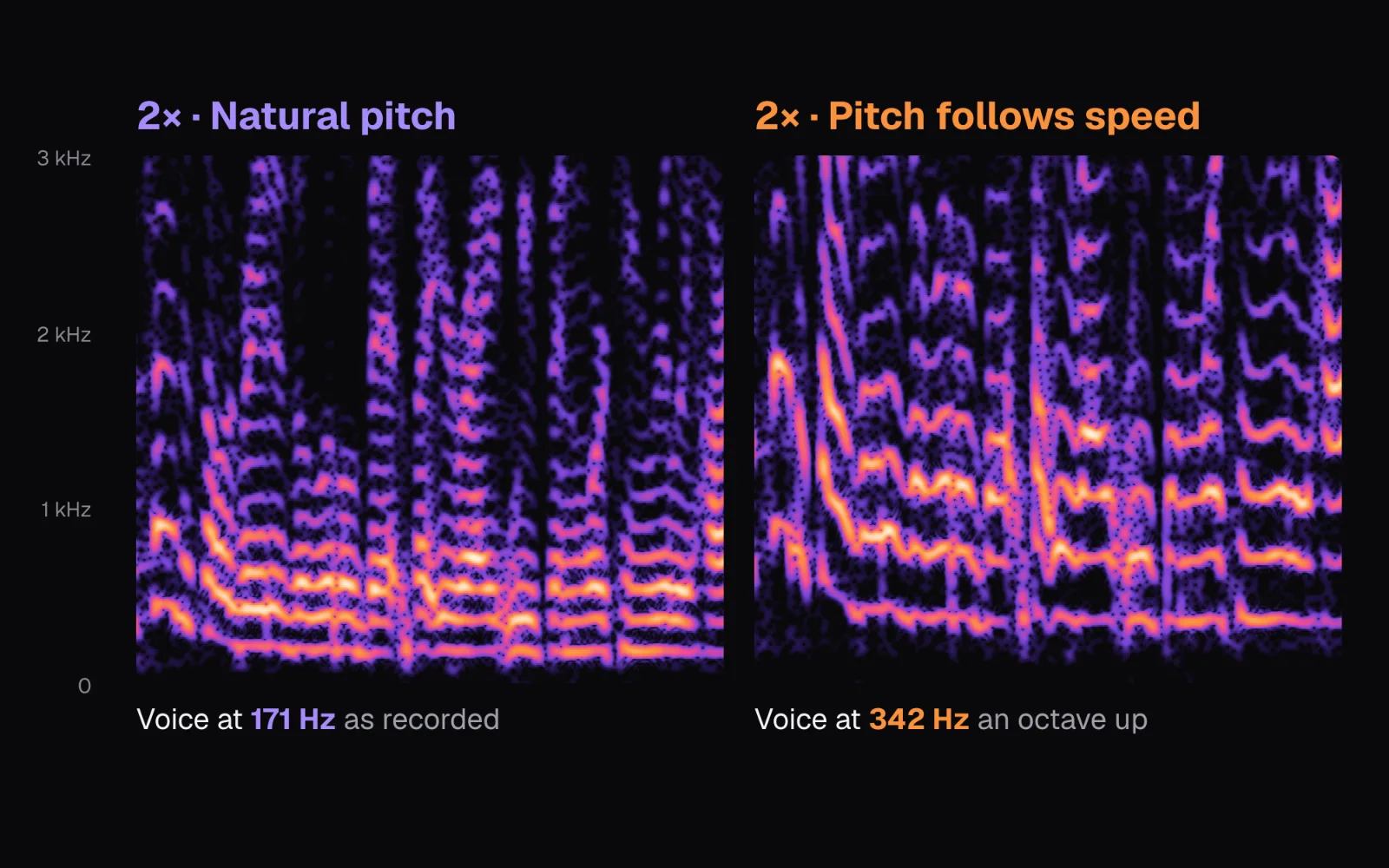
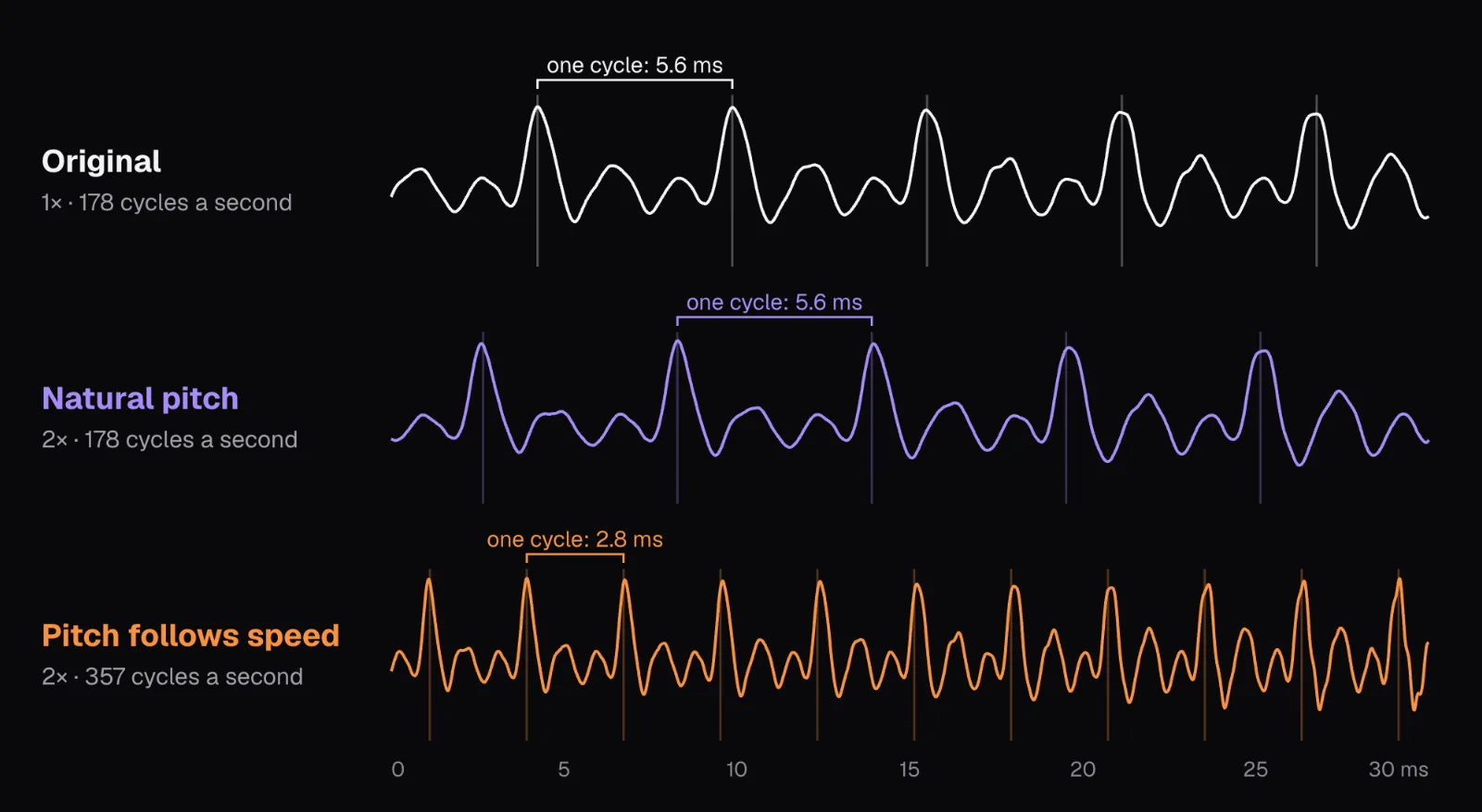
In one steady vowel of Meir's answer, 1 minute 16.6 seconds into the interview, her wave repeated every 5.6 milliseconds: 178 cycles a second, or 178 Hz. A digital recording stores that wave as samples, 48,000 per second in both of our files. Play those samples in half the time and each cycle lasts half as long, 2.8 ms, so the same vowel now repeats 357 times a second. Doubling a frequency raises a note by an octave, which musicians divide into 12 semitones; any speed-up of this kind moves the pitch by 12 × log₂(speed) semitones.
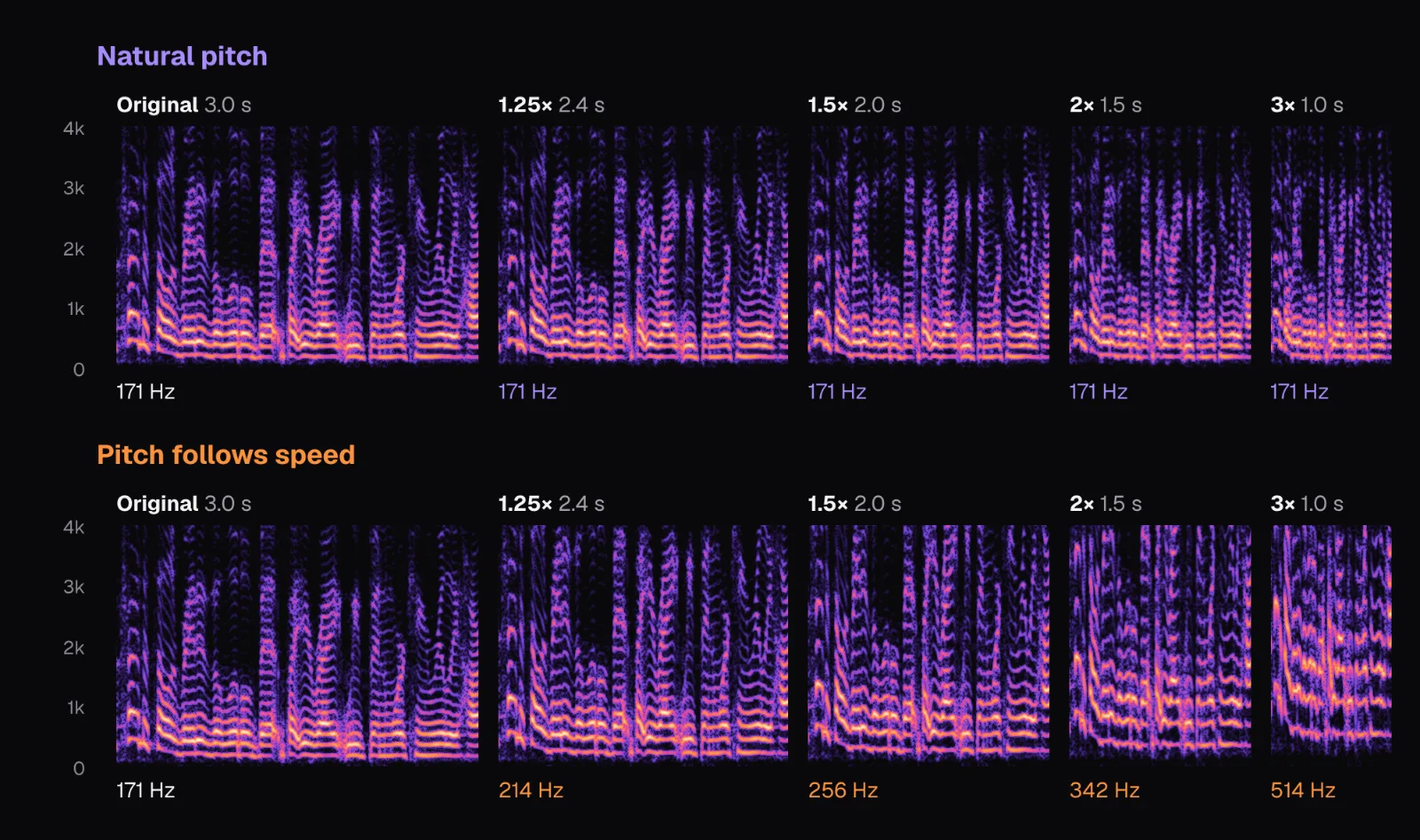
A wave that repeats 178 times a second is made of frequencies at whole multiples of 178 Hz: the fundamental and its harmonics. On a spectrogram, which draws time from left to right and frequency from bottom to top, they show as evenly spaced bright stripes, like the ones in the picture at the top of this page. The resonating throat, nose and mouth make some of those stripes stronger and others weaker, a pattern you can watch change from one sound to the next. NIDCD adds that a voice's pitch and tone are determined “by the size and shape of the vocal folds and the resonating cavities.”
A plain speed-up multiplies every one of those frequencies by the same number. The stripes spread apart and the strong bands climb with them, so the result isn't the same voice saying the words higher. It's a voice whose fundamental and whose shaping both changed at once.
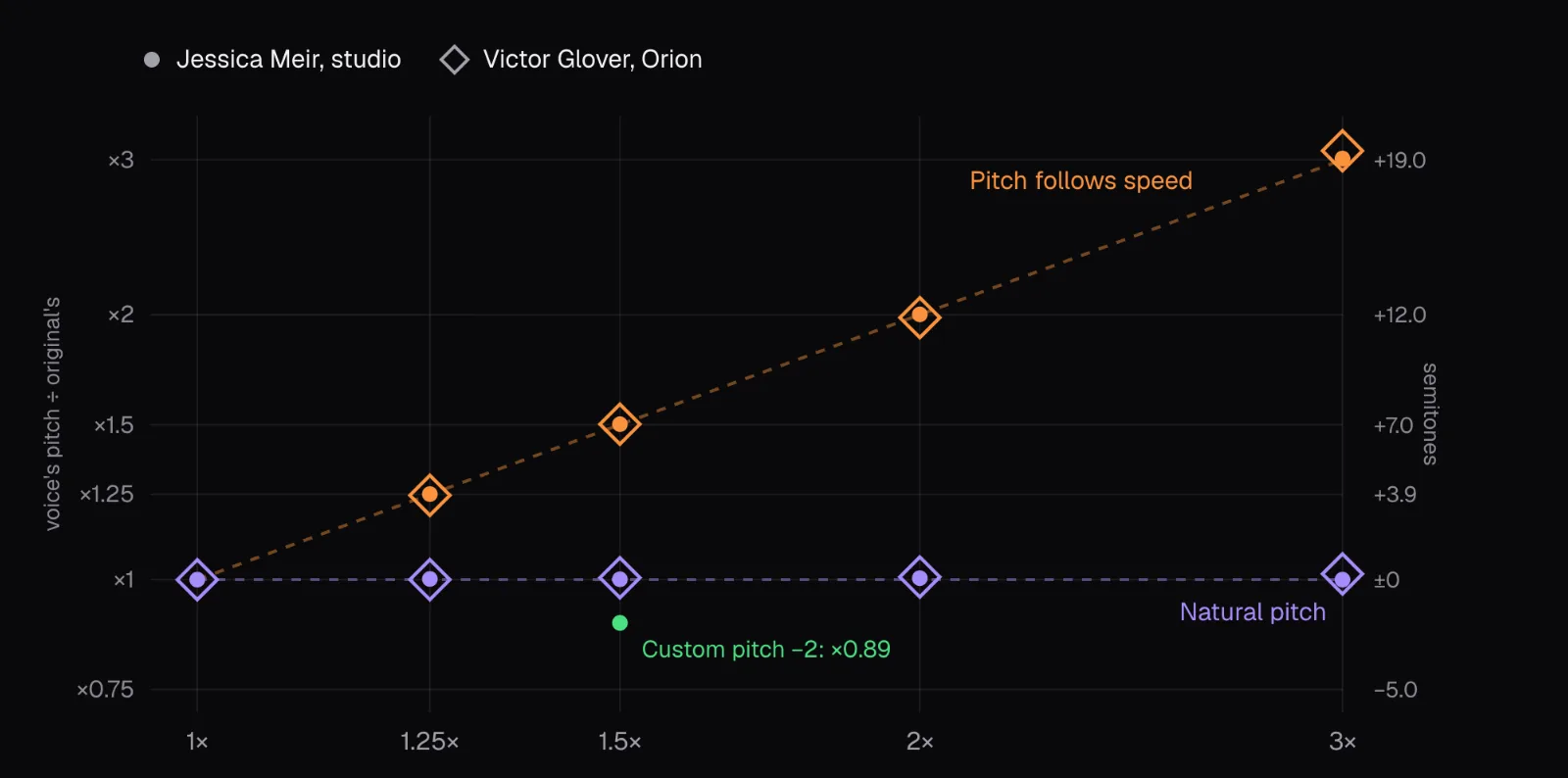
Pitch follows speed: the tape effect, measured to the semitone
Cutlia's “Pitch follows speed” setting does exactly that, on purpose: its description in the editor reads “Faster sounds higher, slower sounds deeper — like “sped up” and “slowed” songs.” In the code it's pure resampling: the samples are treated as if they had been recorded at the speed times the original rate, the way a tape or a record behaves when it's played too fast. Nothing is cut out, so nothing can sound choppy, and nothing keeps the pitch either.
We measured the pitch with autocorrelation: every 10 ms, take 30 ms of the sound, slide a copy of it along itself, and find the shortest shift at which the copy lines up again. That shift is one cycle; one second divided by it is the pitch. Frames where nothing lines up well, such as consonants, breaths and silence, are left out, and the median of the rest is the voice's typical pitch. Meir's 31.5 seconds measured 170.8 Hz in the original; Glover's 30 seconds, 136.8 Hz.
| Pitch follows speed | Meir | Glover | Arithmetic says |
|---|---|---|---|
| 1× (original) | 170.8 Hz | 136.8 Hz | — |
| 1.25× | 213.7 Hz (+3.88 semitones) | 170.7 Hz (+3.83) | +3.86 |
| 1.5× | 256.4 Hz (+7.04) | 205.6 Hz (+7.05) | +7.02 |
| 2× | 341.9 Hz (+12.02) | 271.7 Hz (+11.87) | +12 |
| 3× | 514.0 Hz (+19.08) | 420.4 Hz (+19.43) | +19.02 |
Both voices moved up by the speed and nothing else: Meir's 2× file measured 2.002 times her original pitch. Glover's numbers wander a little more because his recording is noisier and fewer of its frames are clearly voiced: 436 of 2,996 in the original, against 1,693 of 3,146 for Meir.
The resonances moved with the pitch. We averaged each file's spectrum over all its speech and checked how far the whole curve had shifted to match the original's. With pitch following speed it shifted by a factor of 1.26 at 1.25×, 1.50 at 1.5×, 2.00 at 2× and 2.91 (Meir) or 3.00 (Glover) at 3×, measured in steps of a 24th of an octave, about 3%: the strong and weak bands climbed as far as the note did, to within one step. Even the gentlest preset, 1.25×, raises a voice by almost 4 semitones.
How Natural pitch shortens a voice without raising it
To make speech faster without changing its pitch, every cycle has to keep its length. The only way to finish sooner, then, is to play fewer cycles: at 2×, about half of the sound is left out, some 20 milliseconds at a time, and the pieces that stay are joined without gaps. This is called time-stretching, or time-compression when it shortens, and the difficulty is all in the joins. Two slices cut at random meet out of step, and their waves partly cancel each other where they overlap.
Cutlia's “Natural pitch” uses a method called WSOLA, waveform-similarity overlap-add. Its code builds the faster sound from 40 ms frames laid down every 20 ms, each faded in and out with a curve chosen so that two overlapping frames always add up to full volume. At 2×, the place each frame should come from moves 40 ms along the original for every 20 ms of output. Before copying a frame, the stretcher looks up to 12 ms either side of that place and picks the spot whose first 20 ms best match the last 20 ms of the frame before, the stretch the two will be faded across. The waves then cross-fade in step.
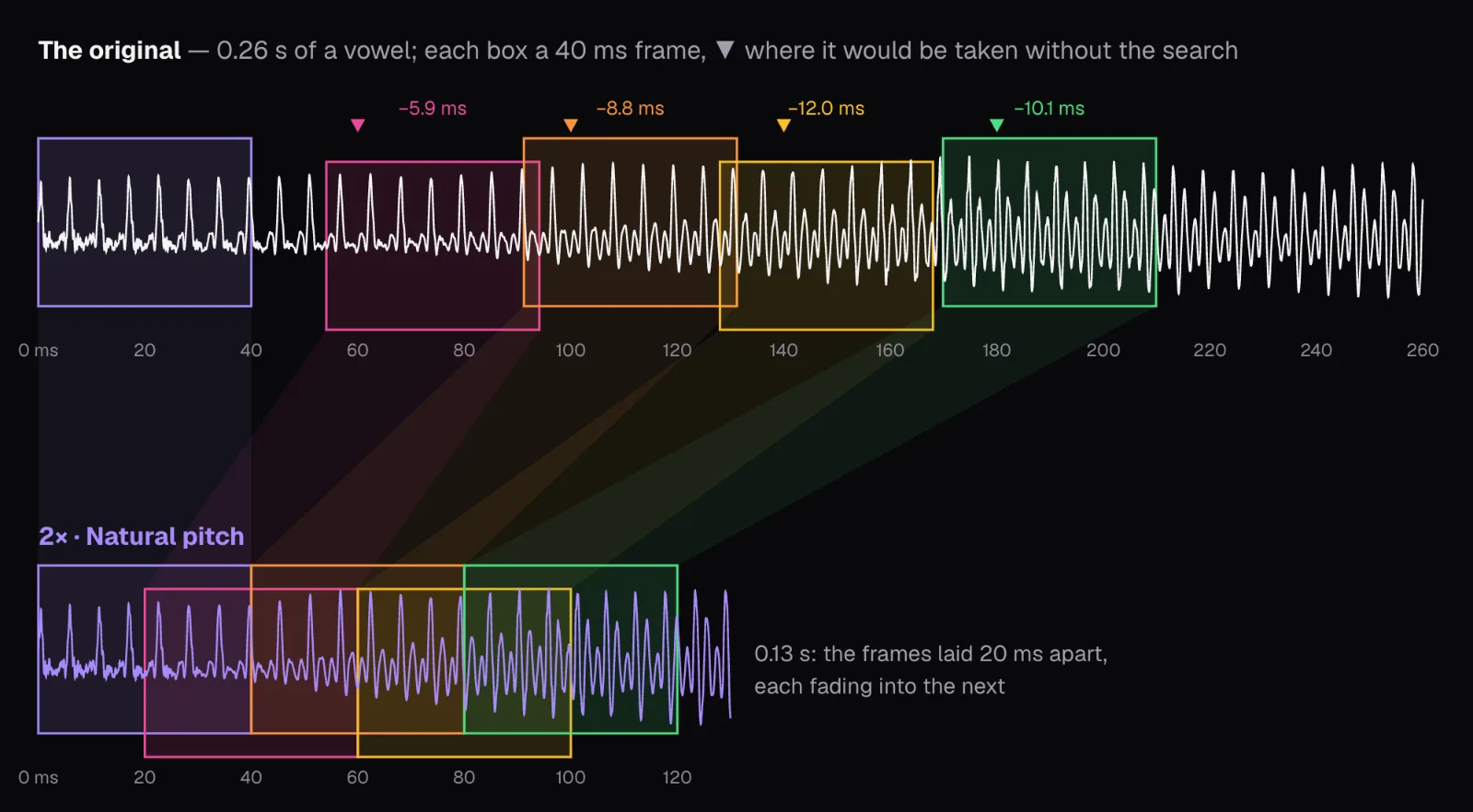
In that quarter-second, the search moved every frame after the first, by 5.9, 8.8, 12.0 and 10.1 ms earlier, so none of those four came from exactly where the clock said, and one went to the edge of the 12 ms limit. The limit is wide enough for a speaking voice: a whole cycle of Glover's 137 Hz lasts 7.3 ms, so a matching point is always within reach. A few more details from the code explain why the result holds together:
- Stereo stays together. The match is found on a mix of the channels, and every channel is cut at the same points.
- Silence doesn't drift. Where nothing matches better, such as in silence, the frame stays where the clock puts it.
- The length is exact. The output is the input's length divided by the speed, rounded to the nearest sample.
- Where it works best. The stretcher's own notes call it “clean for speech and fine for music from roughly 0.5× to 2×; usable well beyond.”
Both lab studies of fast speech we cite below made their fast speech with a close relative of the method. The one by Penn and colleagues, published in the Journal of the Acoustical Society of America, sped up its recordings with a pitch-synchronous overlap-and-add procedure in the program Praat, and its authors note that with it “the formant patterns and other spectral properties of the time-compressed signal are preserved” and the pitch contour “remains the same.” The 2023 study made its fast sentences with the same algorithm in Praat. That makes their results about speed-ups like “Natural pitch”, not about the tape effect.
The same voice in a shorter file: what we measured
With “Natural pitch”, Meir measured 171.1 Hz at 1.25×, 171.0 Hz at 1.5×, 171.4 Hz at 2× and 170.8 Hz at 3×, all within 0.4% of her 170.8 Hz. Glover stayed within 0.7% up to 2× and measured 1.5% high at 3×, from only 80 clearly voiced frames in a 10-second file. The averaged spectrum didn't shift by even one 24th-of-an-octave step at any speed.
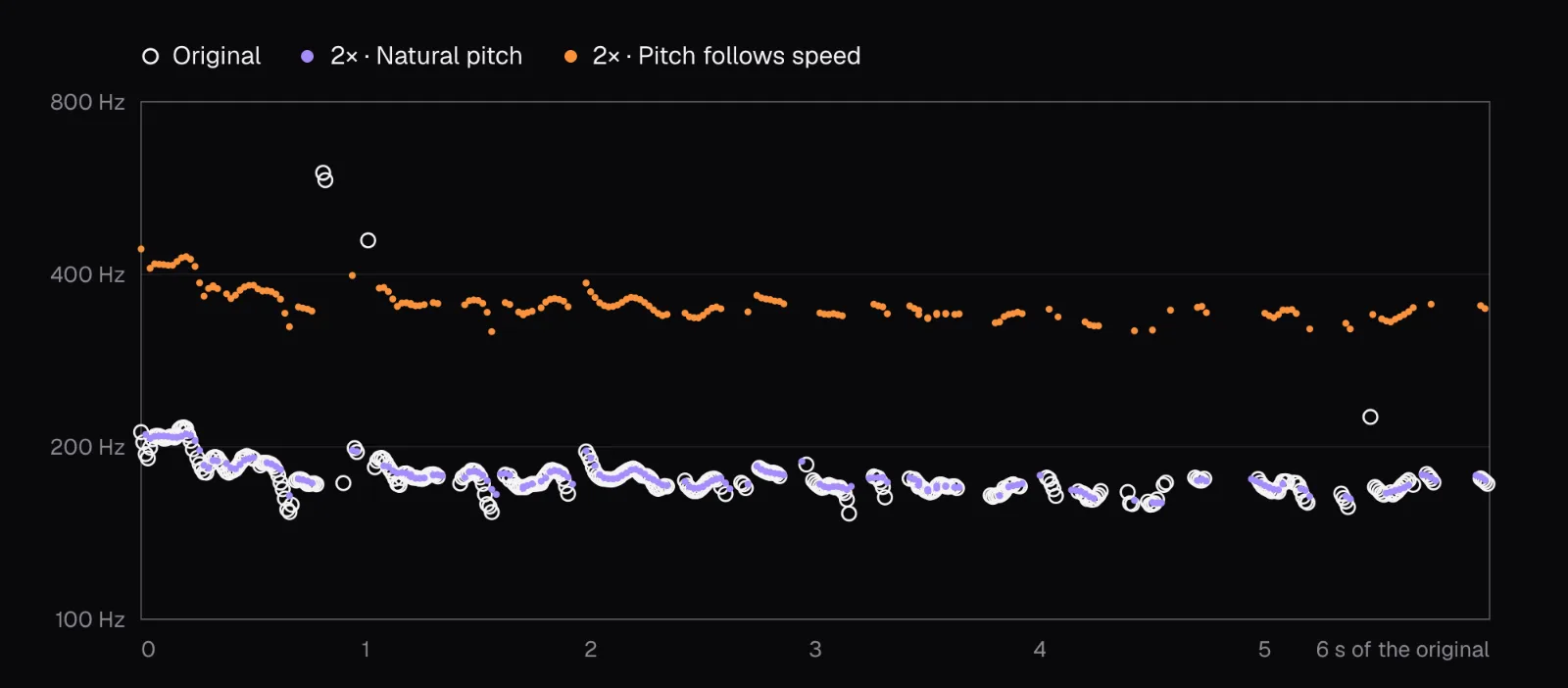
A median can hide a lot, so we also laid the pitch of Meir's 2× files over the original, frame by frame, each moment matched to the moment of the original it came from. With “Natural pitch”, the rise and fall of her sentence came through unchanged: the same fall from its first note, the same dips, the same level stretches, just in half the time. With the pitch following speed, the same melody ran an octave higher.
Both settings gave the same lengths, to the millisecond, so the picture and the sound stay together whichever you pick. Each file came out the part's length divided by the speed, plus 24 to 39 ms:
| Speed | Meir: 31.5 s becomes | Frames | Glover: 30 s becomes | Frames |
|---|---|---|---|---|
| 1× | 31.53 s | 756 | 30.04 s | 900 |
| 1.25× | 25.24 s | 605 | 24.02 s | 720 |
| 1.5× | 21.03 s | 504 | 20.03 s | 600 |
| 2× | 15.79 s | 378 | 15.04 s | 450 |
| 3× | 10.54 s | 252 | 10.03 s | 300 |
The frame counts show what happens to the picture. Every file kept its original frame rate, 23.976 frames a second for the studio and 29.97 for the call, and simply had fewer frames: at 2×, every other one. Change Speed builds the output on the source's own frame rate (up to 60 frames a second), skipping frames to go faster and repeating them to go slower. Slowing down is a different story for the picture, told in our guide to slow motion and frame rates.
Change Speed's sound settings, one by one
Open a video in Change Speed and it starts at 2× with “Natural pitch”. The presets run from 0.25× to 4×, and a slider under them, from “Slower” to “Faster”, sets any speed in that range, rounded to a hundredth. It's logarithmic, so 0.5× and 2× sit equally far from 1×. Under it, a line says what the speed does to the length: “Length 0:31.5 → 0:21.0” for Meir's answer at 1.5×.
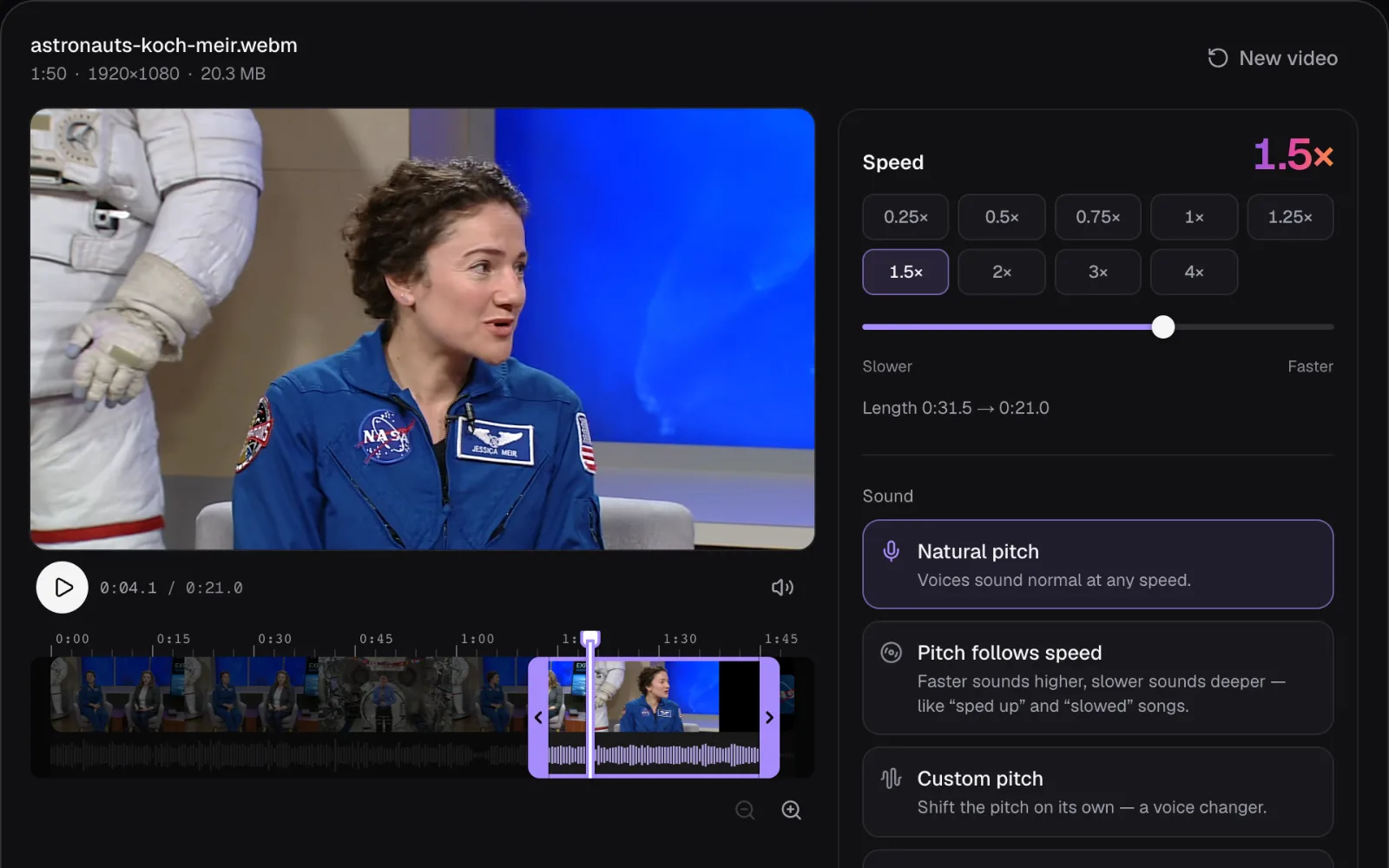
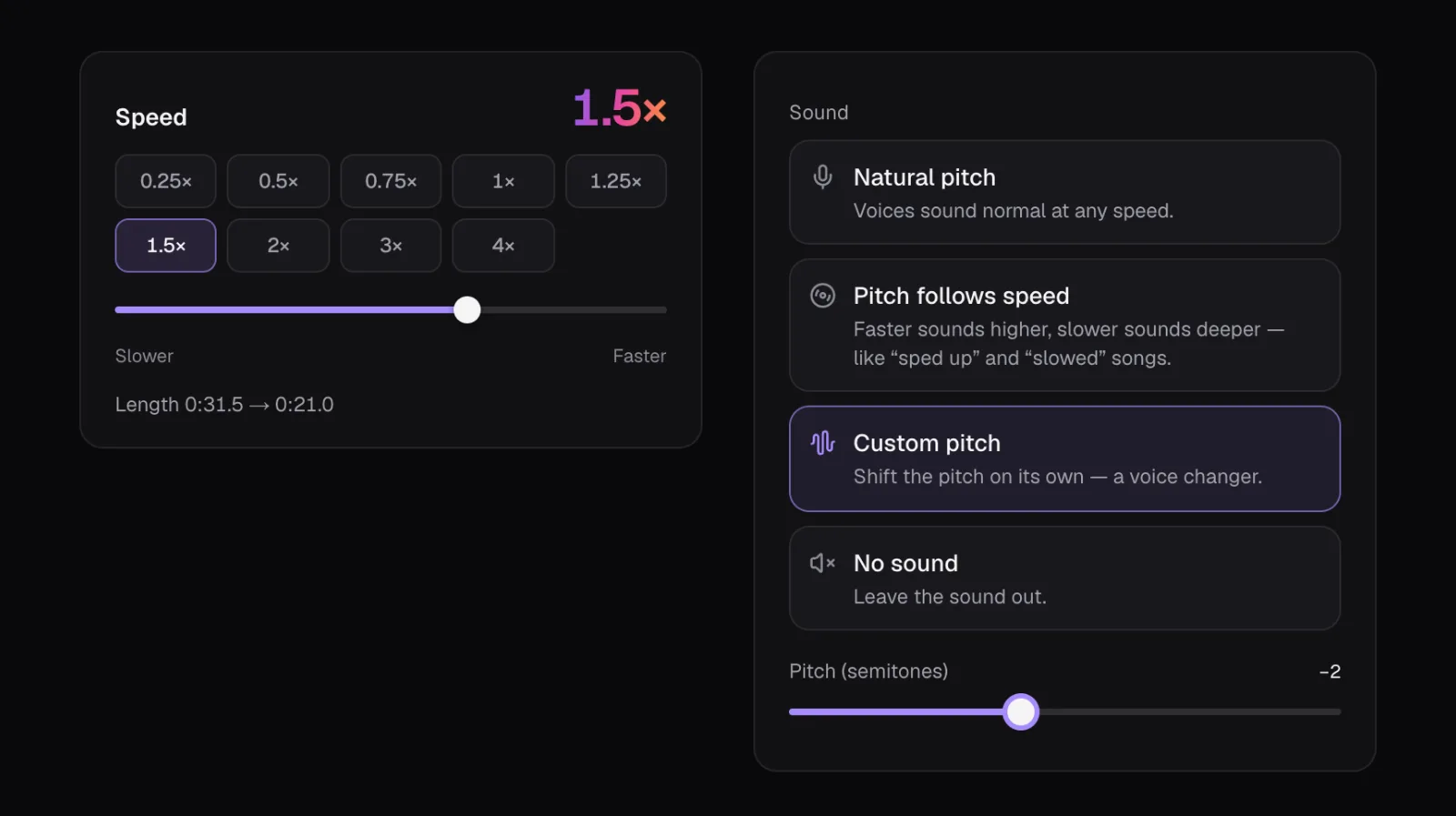
The “Sound” section has four choices:
- “Natural pitch”, “Voices sound normal at any speed.” The export is time-stretched with WSOLA, as above.
- “Pitch follows speed”: resampled, the tape effect. Use it when you want the sound of a sped-up or slowed-down song.
- “Custom pitch”, “Shift the pitch on its own — a voice changer.” A “Pitch (semitones)” slider from −12 to +12 appears. The shift counts from the recording's own pitch, whatever the speed: the sound is time-stretched by the speed divided by the pitch change, then resampled by the pitch change. So +12 at 2× gives the same result as the tape effect, and −2 at 1.5× gave us Meir at 152.5 Hz, 0.893 of her pitch, against the 0.891 that two semitones should make.
- “No sound”, “Leave the sound out.”
The preview and the export reach the same sound differently. While you edit, the preview plays the video at the chosen rate and lets the browser keep the pitch, which is its default, or switches that off for the tape effect; a custom pitch goes through a small pitch shifter of Cutlia's own. The exported file is made by the WSOLA stretcher and resampler described above, so it can sound slightly different from the preview, and it's the file that counts.
The “Part” section keeps only the stretch between its “Start” and “End” times, which is how we cut each answer out of its recording. To cut a video down to one part without changing its speed, Trim Video does only that. The result is an MP4 with the picture encoded again, except at 1× with the pitch unchanged, when an H.264 or HEVC picture is copied as it is. Our WebM files hold VP9 and AV1 pictures, so even their 1× exports were re-encoded as H.264.
How fast can speech go before people stop following it?
Keeping the pitch solves the chipmunk problem, but a speed-up also packs more syllables into every second, and listeners can only take in so many. Research on fast speech counts it that way, in syllables per second. A 2023 study in Scientific Reports by Gransier, Peeters and Wouters sums up earlier work: the speed at which young listeners with normal hearing still catch half of time-compressed speech “ranges from 11 to 16 syllables per second”, it varies a lot from person to person, and the ability to follow it declines with age. In the study itself, 14 young adults with normal hearing understood Dutch sentences compressed to 6.6 syllables per second almost completely: 99.8% of the key words on average.
Age matters a great deal. In the study by Penn and colleagues, listeners repeated strings of four digits recorded at 3 syllables per second and compressed to between 6 and 21. The young adults, aged 18 to 33, were at or near perfect at 6 and 9, while the older adults, aged 62 to 90, were “at floor level with speech rates as early as 12 syllables per second.”
So we counted our speakers. Video to Text transcribed both 1× files, we counted the syllables of every word by hand, 180 for Meir and 97 for Glover, and divided by the time from first word to last, pauses included. Meir talks fast: 5.8 syllables a second, 247 words a minute. Glover, who paused between thoughts, averaged 3.3 a second and 137 words a minute. The same speed setting puts them in very different places:
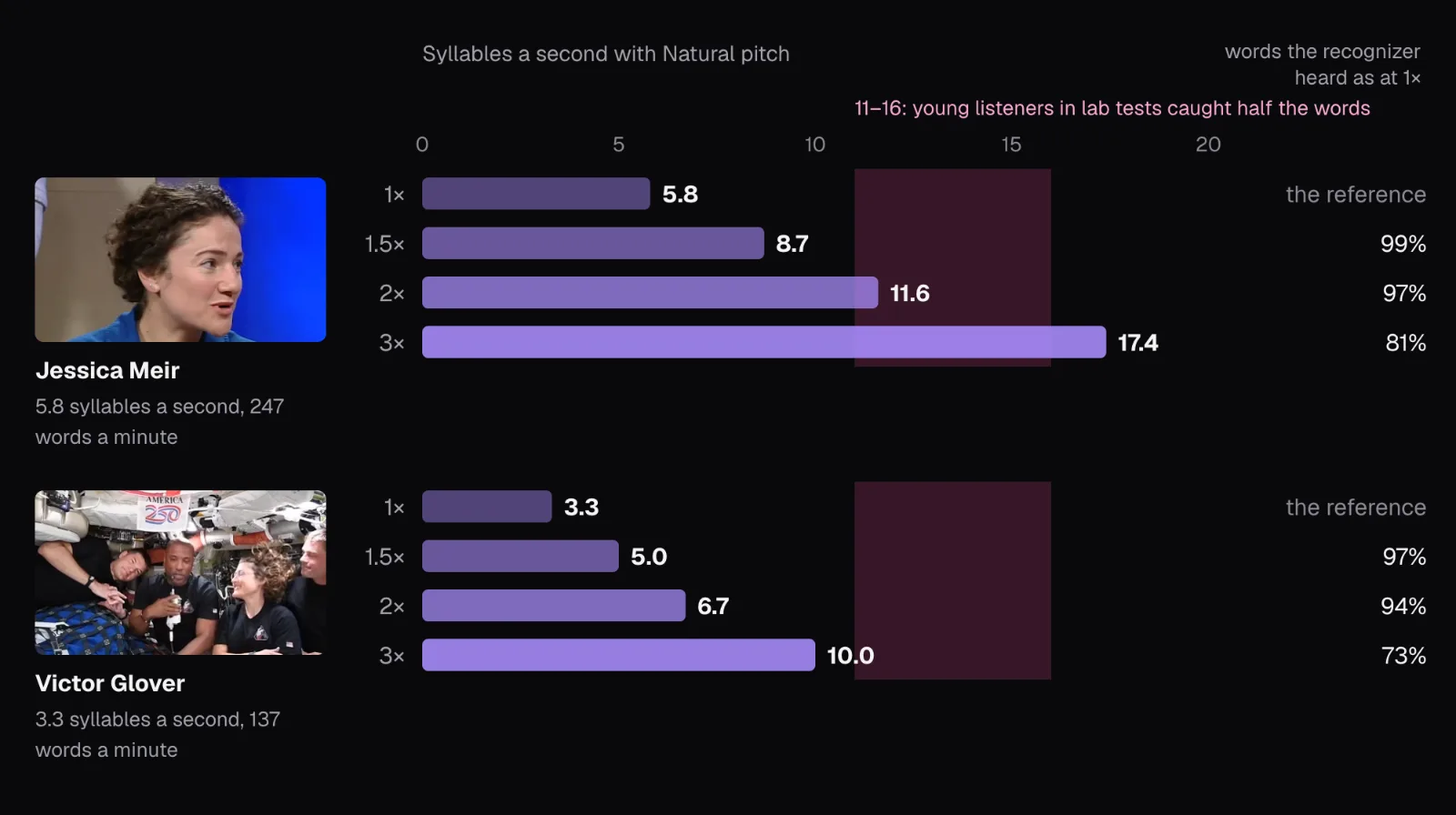
Then we gave the files to a machine listener: Cutlia's Video to Text, which runs the Whisper speech-recognition model in the browser. Taking each voice's 1× transcript as the reference, we counted how many of its words came out the same in the faster files. With “Natural pitch”, Meir's 128 words survived almost whole: 127 at 1.5× and 124 at 2×, where “I tried to celebrate” became “I'm trying to celebrate”. At 3× it kept 103 and started making things up: “selected back as astronaut candidates” came out as “selected back in Kansas”, and “the co-pilot of the Soyuz” as “the pilot, the stories”. Glover's rougher sound lost more: 97%, 94% and 73% of his 66 words at 1.5×, 2× and 3×, with “translunar injection” turning into “triangular injection” at 3×.
The tape-sped files did nearly as well at 1.5× and 2×: 127 and 123 of Meir's words, 95% and 91% of Glover's. At 3× they fell apart. For Meir, Video to Text wasn't sure which language it was hearing and asked, offering English or Russian; told English, it wrote down one sentence she never said: “This video is made possible by the video.” For Glover it offered Russian first; told English, it reported “No speech found”.
A recognizer isn't a viewer. It shows that the words are still in the sound at 2×, not that a person can keep up with them: by the lab numbers, Meir at 2× is already as fast as speech where some young listeners lose half of it. Our counts include each answer's pauses; leaving out the gaps of a quarter-second or more, Meir speaks at 6.2 syllables a second, and at 12.3 when doubled. (Glover's 1× transcript also stops five words short of the end, which the faster files' transcripts caught, so his true rate is a touch higher.)
Which speed and setting to choose
For anything with speech in it, choose “Natural pitch”. Save “Pitch follows speed” for when the higher or deeper sound is the point, “Custom pitch” for changing a voice on purpose, and “No sound” for footage whose sound you'll replace anyway. Then pick the speed from the speaker, not from a habit:
- Count your speaker. Count the syllables in ten seconds of steady talk and divide by ten, then multiply by the speed you have in mind. In the lab, young listeners understood practically everything at 6.6 syllables a second and lost half the words somewhere between 11 and 16; older listeners reached their limit sooner.
- A fast talker takes 1.25× to 1.5×. Meir at 1.5× reaches 8.7 syllables a second; at 2× she's already at 11.6, inside the range where lab listeners lost half.
- A slow or pausing talker can take 2×. Glover at 2× reaches only 6.7, close to the 6.6 the lab's young listeners followed almost word for word, and less than Meir at 1.25× (7.2).
- Keep 3× for skimming. Both voices kept their pitch at 3×, but the recognizer started mishearing whole phrases, and Meir reached 17.4 syllables a second, above the lab range.
Before you speed anything up, cut the long pauses. A speed-up shortens pauses and words by the same factor, so a 2-second silence still lasts a second at 2× while the words around it get harder to follow. Cutting the pauses with Remove Silence shortens a talk without making its speech any faster; our guide to removing silences and jump cuts measures how much it takes out of these same two NASA recordings. A gentle 1.25× afterwards takes another fifth off without adding many syllables a second: Meir, with her pauses of a quarter-second or more left out, reaches 7.7 at 1.25×.
The tools in this guide
Change Speed
Slow motion, timelapse, or just a little faster.
Remove Silence
Dead air out, every word kept — a tighter video in a minute.
Trim Video
Cut the start, end or middle of any clip in seconds.
Video to Text
Transcripts in 100 languages, with speakers and timestamps — made on your device, never uploaded.
Questions people ask
Why does sped-up audio sound like chipmunks?
Played faster, every cycle of the sound wave gets shorter, so every frequency in it is multiplied by the speed: the voice's pitch and the resonances that color it. At 2× our two speakers measured 2.00 and 1.99 times their own pitch, an octave up. Pitch-keeping speed-ups avoid it by leaving out short slices of sound instead of squeezing them; in Cutlia that's the “Natural pitch” setting in Change Speed.
Does Natural pitch change the voice at all?
Its pitch barely moves: our studio speaker measured within 0.4% of her original at 1.25×, 1.5×, 2× and 3×, and the averaged spectrum of her voice didn't measurably shift. What changes is timing. To finish sooner, the stretcher leaves out short slices of sound, choosing each join so that the waves line up and cross-fade in step instead of partly canceling each other.
How much shorter does 1.5× speed make a video?
Divide the length by the speed: 1.5× takes a third off, 2× takes half and 1.25× takes a fifth. Our 31.5-second clip became 21.03 seconds at 1.5× and 15.79 at 2×, a few hundredths over the arithmetic. Change Speed shows the result before you export, in a line such as “Length 0:31.5 → 0:21.0”.
Can I speed up a video and make the voice deeper at the same time?
Yes, with a pitch shift that's separate from the speed. In Change Speed, choose “Custom pitch” and set the semitones: we exported a clip at 1.5× with −2 semitones and measured the voice at 0.893 of its original pitch, against the 0.891 that two semitones down should give. Twelve semitones make an octave, so −2 lowers a voice by a sixth of one.
What speed is too fast for speech?
It depends on the speaker more than on the number. Lab studies measure speech in syllables per second, and in tests of sped-up speech, young listeners with normal hearing caught only half the words somewhere between 11 and 16 syllables a second. Our fast-talking studio speaker reached 11.6 at 2× and 17.4 at 3×; a slower speaker reached 6.7 at 2×. Older listeners reach their limit sooner.
Sources
Where the facts in this guide come from, besides our own tests:
- Taking Care of Your Voice — National Institute on Deafness and Other Communication Disorders (NIH)
- HTMLMediaElement: playbackRate property — MDN Web Docs
- HTMLMediaElement: preservesPitch property — MDN Web Docs
- The importance of temporal-fine structure to perceive time-compressed speech with and without the restoration of the syllabic rhythm (Gransier, Peeters and Wouters, Scientific Reports 13, 2874, 2023) — Scientific Reports
- The possible role of brain rhythms in perceiving fast speech: Evidence from adult aging (Penn, Ayasse, Wingfield and Ghitza, J. Acoust. Soc. Am. 144(4), 2018) — PubMed Central (NIH)
- Astronauts Koch and Meir React to International Space Station Mission Updates: the footage's record — Wikimedia Commons (NASA)
- Artemis II and Space Station Expedition 74 Astronauts Call in Space: the footage's record — Wikimedia Commons (NASA Johnson Space Center)
Footage in this guide
The pictures were made with Cutlia's tools from this openly licensed footage, found on Wikimedia Commons:
- Astronauts Koch and Meir React to International Space Station Mission Updates — NASA, Public domain
- Artemis II and Space Station Expedition 74 Astronauts Call in Space (jsc2026m000083) — NASA Johnson Space Center, Public domain